In arid and semi-arid regions—from the coastal plains of Spain to the desert orchards of Oman and Yemen—soil salinity is a silent thief of yield. High concentrations of sodium (
Na+) and chloride (
Cl−) ions not only degrade soil structure but also cause “physiological drought,” where plants cannot absorb water even when the soil is wet.
For professional growers, mineral-source humic acid has become a critical tool for managing salt stress and restoring productivity to degraded lands.
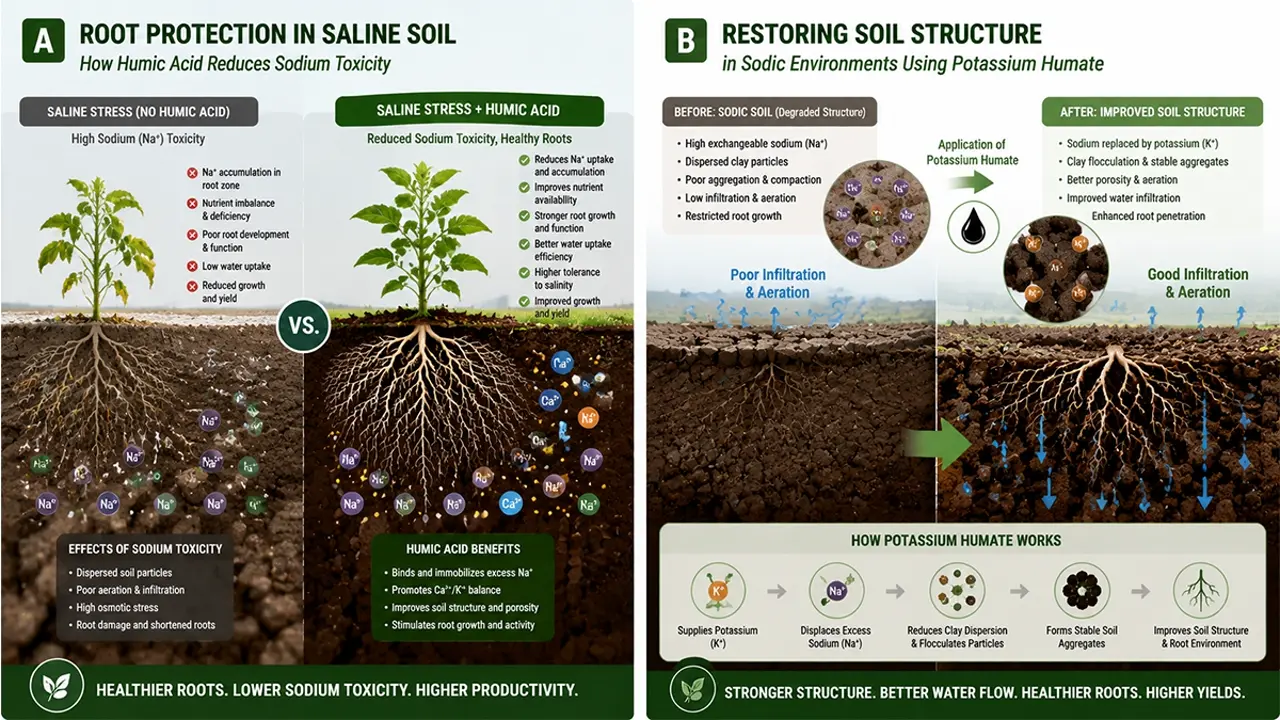
1. The Chemical Shield: Cation Exchange Capacity (CEC) in Action
The primary challenge in saline-alkali soil is the dominance of sodium ions, which displace essential nutrients and destroy soil “crumb structure.”
- Buffering Sodium Toxicity: Humic acid possesses an exceptionally high Cation Exchange Capacity (CEC). Its molecular structure is rich in negatively charged functional groups that act as a “chemical magnet.” These groups bind with excess sodium ions, preventing them from being absorbed by the plant roots in toxic quantities.
- Unlocking Nutrients: As humic acid sequesters sodium, it releases beneficial cations like Calcium (
Mg2+), and Potassium (
K+) back into the soil solution, restoring the nutritional balance needed for healthy growth.
2. Restoring Soil Structure: Reversing “Sodification”
High sodium levels cause soil particles to disperse, leading to surface crusting and poor drainage—a process known as sodification.
- Aggregation and Aeration: Humic substances act as a biological glue, binding fine particles into stable aggregates. This restores the soil’s porosity, allowing fresh irrigation water or rainfall to leach excess salts down past the root zone (leaching).
- Improved Permeability: By opening up the soil profile, humic acid ensures that the rhizosphere (root zone) receives the oxygen it needs to function, even in heavy, salt-affected soils.
3. Physiological Protection: Maintaining Osmotic Balance
Salt stress triggers “osmotic shock,” forcing water out of the plant cells and leading to wilting and stunted growth.
- Osmotic Adjustment: Humic acid stimulates the plant to accumulate “compatible solutes” (like proline and organic acids). This increases the internal osmotic pressure of the roots, allowing them to continue drawing moisture from salty soil.
- Membrane Integrity: Research shows that humic acid helps maintain the stability of cell membranes. By protecting these membranes from the corrosive effects of sodium, the plant can better regulate ion transport and prevent “salt burn” on the leaves.
4. Strategic Integration for Saline Agriculture
For growers in high-salinity regions, KHUMIC recommends a dual-action approach:
- Soil Application (Granules/Powder): Apply KHUMIC-100 (Potassium Humate) or FulvicPlus directly to the soil to improve CEC and structural porosity.
- Foliar Rescue (Aminomax/Seaweed): Use amino acids and seaweed extracts to provide an immediate energy boost and antioxidant protection, helping the crop survive peak heat and salinity periods.
Conclusion: Turning Saline Soil into Productive Land
Soil salinity management is not just about survival; it is about long-term profitability. By restoring the chemical and physical health of your soil with KHUMIC’s mineral humic solutions, you can protect your investment and achieve consistent yields in the most challenging environments on Earth.
Secure your harvest in high-sodium soils. Contact KHUMIC’s technical team today for a customized salt-mitigation fertilization program.