As the global fruit industry pivots toward “net-zero” commitments, large-scale export orchards are facing a new strategic imperative: ESG Compliance. Major retailers and international markets, particularly under the EU Green Deal and similar frameworks, now demand transparency regarding the carbon footprint of agricultural products.
At the heart of this transition is Carbon Sequestration in soil—and the most effective tool for achieving it is the strategic application of Humic Substances.
1. Humic Substances: The Invisible Pillar of Soil Carbon Sequestration
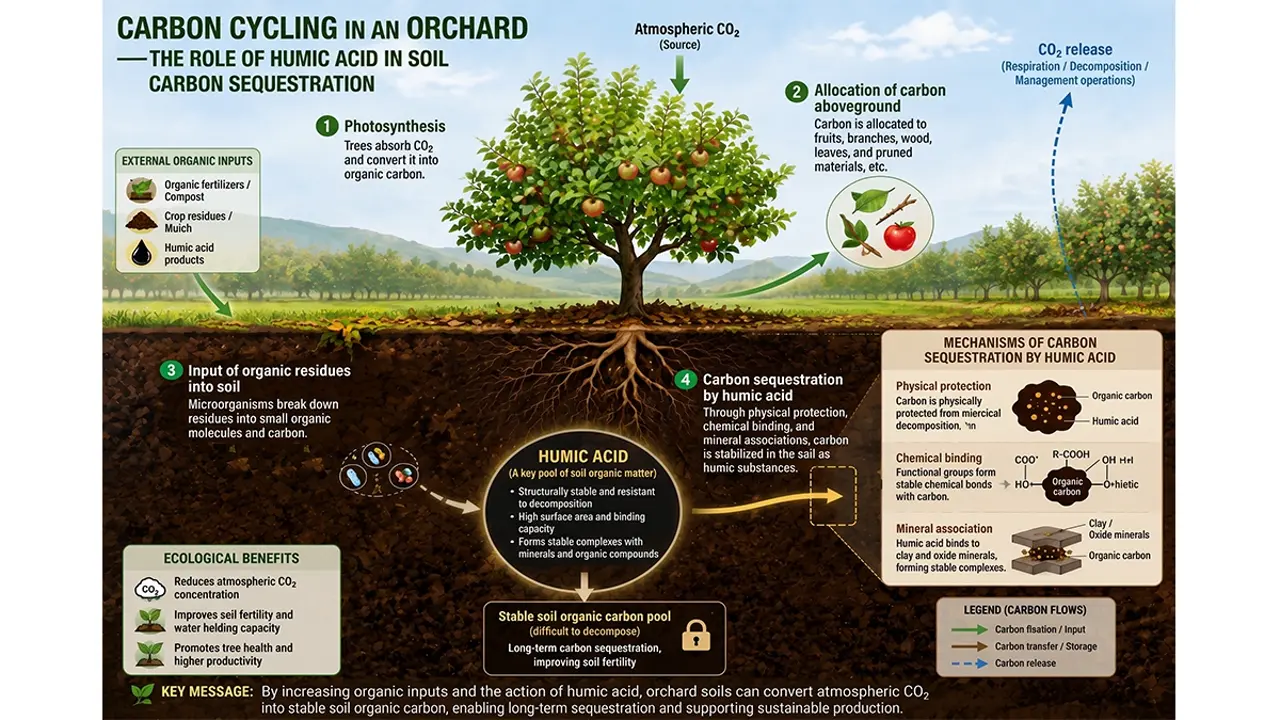
Soil is the second-largest carbon sink on Earth, and Soil Organic Carbon (SOC) is the key metric for orchard sustainability. Unlike rapidly decomposing organic matter (like fresh compost), humic substances are highly stable.
- Long-Term Carbon Storage: Mineral-source humic acids represent the most stable fraction of soil organic matter. They can remain in the soil for decades, effectively “locking away” atmospheric CO2 that was captured by the fruit trees during photosynthesis.
- Building Soil Organic Matter (SOM): By applying humic and fulvic acids, orchard managers directly increase the recalcitrant carbon pool, which is a primary requirement for Carbon-Smart Farming certifications.
2. Meeting ESG Agriculture Standards with Mineral Humics
For exporters, ESG is no longer just a buzzword; it is a regulatory and financial requirement. Humic substances support the three pillars of ESG:
- Environmental (E): Beyond carbon sequestration, humic substances improve water-use efficiency and reduce nutrient leaching. This minimizes the environmental impact of chemical runoff into local ecosystems.
- Social (S): Healthy, fertile soils ensure long-term food security and support the livelihoods of local farming communities by preserving the land for future generations.
- Governance (G): Utilizing science-backed, OMRI-listed mineral humics provides a clear, auditable trail of sustainable input management, facilitating compliance with GlobalG.A.P. and other international standards.
3. Sustainable Orchard Management: Resilience in a Changing Climate
Modern orchards face unprecedented climate volatility. Sustainable orchard management must go beyond simple nutrition; it must focus on building a resilient “biological infrastructure.”
- Drought and Heat Resilience: Humic substances improve soil structure (aggregation), allowing orchards to retain moisture longer during heatwaves—a critical factor for crops like cherries, avocados, and citrus.
- Nitrogen Optimization: By enhancing Nitrogen Use Efficiency (NUE), humic acids allow growers to reduce synthetic nitrogen applications. Since synthetic nitrogen production is a major source of GHG emissions, this reduction directly lowers the orchard’s overall carbon footprint.
4. The Competitive Edge for Exporters: Green Branding
In 2026, a “carbon-positive” or “climate-neutral” label is a powerful marketing tool. Large orchards that can demonstrate active carbon sequestration through soil health programs gain a significant advantage:
- Market Access: Preferred status with premium retailers focusing on sustainable sourcing.
- Premium Pricing: Ability to command higher prices for products with a lower environmental impact.
- Future-Proofing: Preparedness for future carbon taxes or mandatory emissions reporting in global trade.
Conclusion: Partnering with KHUMIC for a Sustainable Future
At KHUMIC, we provide more than just agricultural inputs; we provide the foundation for ESG-compliant farming. Our high-purity, mineral-source humic and fulvic acid solutions are designed to help modern orchards maximize productivity while achieving their carbon sequestration and sustainability goals.
Elevate your orchard’s ESG profile. Contact KHUMIC today to integrate carbon-smart humic solutions into your sustainable management program.